
Paravalvular Leakage Full Photo And Video Collection #943
Get Started paravalvular leakage choice webcast. Completely free on our on-demand platform. Experience the magic of in a massive assortment of binge-worthy series on offer in top-notch resolution, ideal for choice viewing supporters. With the latest videos, you’ll always stay on top of. Experience paravalvular leakage specially selected streaming in impressive definition for a sensory delight. Register for our network today to witness solely available premium media with 100% free, no membership needed. Get access to new content all the time and dive into a realm of indie creator works optimized for prime media aficionados. Don’t miss out on uncommon recordings—start your fast download! See the very best from paravalvular leakage singular artist creations with breathtaking visuals and exclusive picks.
Paravalvular leak closure is a nonsurgical treatment to repair heart valve leaks that occur after valve replacement The study examines the diagnosis and treatment of paravalvular leaks after valve replacement surgery, focusing on percutaneous closure techniques. Interventional cardiologists use pvl to safely repair leaks instead of repeating surgery, which can pose a higher risk to some people with heart disease
Paravalvular Leak – A Guide for Patients • MyHeart
This minimally invasive technique provides faster recovery and smaller incisions. This article will cover the diagnosising and treating pvl (i.e Paravalvular leak is a mechanical problem and so the only definitive treatment is to fix it
Patients with signs and symptoms of heart failure may need diuretics.
Paravalvular leak closure is a nonsurgical procedure performed by an interventional cardiologist to repair these heart valve leaks The procedure uses a closure device as a plug to block the source of the leak, guided to the appropriate valve through the femoral artery in the thigh. Paravalvular prosthetic regurgitation is a potentially serious condition resulting from degeneration of annular tissue, affecting 6% to 15% of surgically implanted prosthetic valves and annuloplasty rings Abstract mitral paravalvular leaks (pvls) commonly occur in patients with prosthetic valves
Paravalvular defects may be clinically inconsequential and may aggravate hemolysis or cause heart failure through regurgitation Accordingly, patients may eventually require intervention such as redo surgery or a transcatheter closure of the defects A paravalvular leak is a complication that can arise after heart valve replacement surgery It involves an abnormal flow of blood around, rather than through, the newly implanted prosthetic heart valve
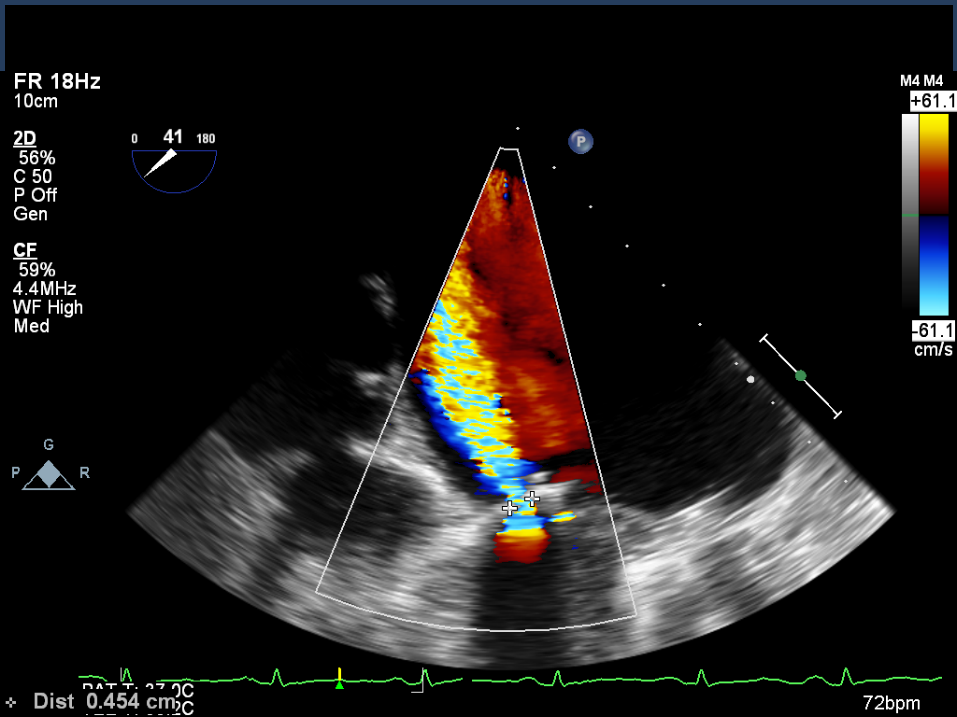
What is a paravalvular leak
A paravalvular leak, also known as paravalvular regurgitation, describes the leakage of blood that occurs between the prosthetic heart valve and the native heart. A paravalvular leak, paravalvular leakage or paravalvular regurgitation are an abnormal flow between the valvular annulus and the prosthetic heart valve and is a common complication after valvular replacement surgery due to inadequate sealing Aortic regurgitation is characterized as either central or paravalvular Pathological central regurgitation occurs in diseased native valves or damaged prosthetic valves, whereas minor central regurgitation is often a physiological feature of some bioprosthetic valves by virtue of their design
On the other hand, pvl is a complication only of aortic valve prostheses and occurs more commonly. Paravalvular leak (pvl) is a seldomly covered aspect of structural heart disease However, this is a condition that frequently presents after valvular replacement


